
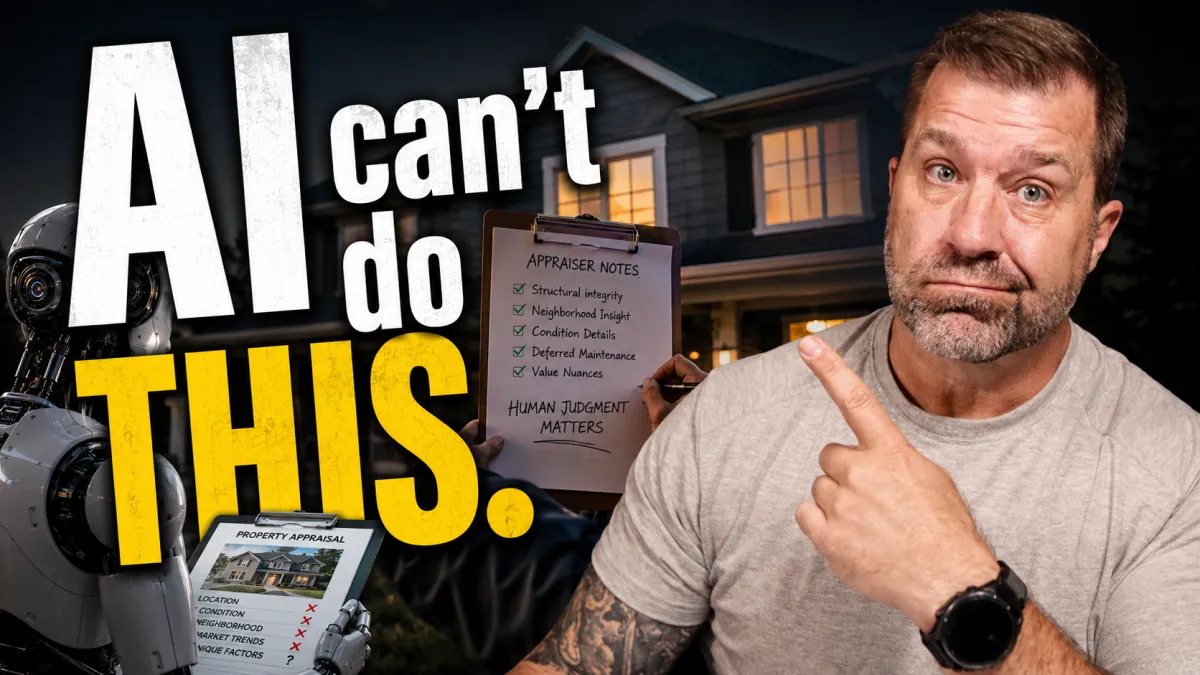
The Doorman Fallacy and what it means for appraisers
Podcast Version-Audio Only
YouTube Version
I was a hotel doorman in downtown Chicago when I was twenty-one years old.
High end hotel. The long coat, gloves, the hat, all of it.
So, when I tell you about something called the Doorman Fallacy, understand that I’m not deliberately reaching for a metaphor. I actually did the job.
Here’s the fallacy. If an efficiency consultant had walked up, watched me for five minutes, and written down what I did, he’d have written two words on his clipboard: "Opens doors".
Maybe, if he was a tad more thorough and stuck around a little longer, he'd write down, "Opens doors, talks to people, hails occasional taxi".
Then he’d have priced out an automatic door, compared it to my hourly wage, and recommended eliminating the position altogether.
And, you know what? He would have been right.
And, in fact, that's exactly what hotels did. The doorman disappeared from almost every hotel in America and the automatic door won. No more human needed. No sick days, no insurance, no benefits, and no human hassles.
The entire appraisal profession, as well as many others (maybe yours) is standing in that same doorway right now.
By the end of this, you’re going to know which side of the automatic door you’re standing on. And I’m going to give you the one thing AI genuinely cannot take from you. But I’ll warn you up front, most appraisers aren’t set up for the change or to charge for it, and that’s the actual problem.
Stay with me, because there’s a specific date coming that most of you are treating as a compliance headache when it’s actually one of the big things accelerating all of this.
The Doorman fallacy comes from a man named Rory Sutherland. He’s an advertising guy, vice chairman at Ogilvy, and he uses the hotel doorman as the example of what happens when a business measures the wrong thing. Which happens all the time, by the way.
As someone who actually was a doorman at a high-end hotel, let me tell you what I actually did on a shift.
I recognized people and learned their names, where they were from, why they were there, and what they liked to do. When a guest walked out and needed a taxi hailed, I'd ask some quick questions to gather some initial intelligence about them. When they returned later that afternoon, I'd ask them how the conference, the meeting, the lunch, or the show was.
That was the initial bridge of trust. When a guest came back for the third time in six months, I knew her name and I used it. I knew which regulars wanted small talk and which ones wanted to be left completely alone.
I moved luggage. I hailed cabs, I answered questions about the city, where to go for the most authentic Ruben sandwich or pasta dish. I scored tickets for shows at the Chicago theater just down the road. And I made arrangements for them at hard to get into places with the help of the concierge.
I gave directions. Real directions. Not “go two blocks and turn left”. It was more like, “don’t walk that way at this hour, take lower Wacker street instead, it's the not so well known short cut”.
I watched the entrance. I knew who belonged there and who didn’t. I was the first layer of security nobody ever thought of as security.
And I set the temperature of the whole arrival. Somebody flies in from Newark, gets stuck on a tarmac for two hours, takes a cab through traffic, and the first human being they encounter is me. What happens in those eight seconds shapes how they feel about that hotel for the rest of their stay.
And none of that shows up on a clipboard.
Now let me give you the same problem in a completely different industry.
More recently, software development had this exact issue. Companies wanted to measure programmer productivity, and somebody came up with an obvious metric: lines of code.
It sounds reasonable. More code means productivity.
Except a mediocre programmer needs five thousand lines to solve a problem a brilliant programmer solves in five hundred. Sometimes the best programmer on the team removes code. Sometimes the person who writes the least creates the most value, because they understood the architecture, saw the real problem, understood the problem better, perceived the nuance in the task, and designed something simpler.
Companies measured what was easy to count instead of what actually mattered.
And this becomes absurd with AI, because AI can generate enormous quantities of code in seconds. If lines of code were really the measure of a great programmer, the machine will win that contest every time and it isn’t even close.
But here's the thing; nobody actually wants lines of code. They want software that works. Nobody wants a half inch drill bit. Buyers of the drill bit want a half inch hole; the drill bit is a tool that provides the solution to that problem. People just want problems solved. That's true in every business regardless of whether or not it's a business with a product to sell or a service to sell.
In the world of software, code is the output of the thinking. It was never the value of the thinking.
Having been an appraiser for the last 26 years and built several appraisal companies, from one person firms to, at one point, one of the largest residential appraisal firms in the country, I have some idea of what often gets measured that shouldn’t, and what should be measured instead. So, what does most of the appraisal industry measure?
Reports completed. Turn time. Adjustments. Fields populated. Pages produced. Reports per week. Dollars per hour.
Every one of those is a production metric.
There’s nothing wrong with production metrics. You need them. But somewhere along the way, appraisers started confusing production with professional value, and that confusion is costly, both to the producer, as well as the buyer of that product or service.
Because here’s how the industry describes what you do. You inspect the house. You measure it. You find some comps. You make adjustments. You fill out the form. You send the PDF. And technology companies look at that description and say, reasonably, we can automate most of that.
Of course they can, and it shouldn’t be insulting. That’s a correct reading of the job description the profession essentially wrote for itself and has been acting on for decades.
The form is the door. The appraiser is the doorman.
The form records what happened. The form is not why anybody hired a professional.
Now think about what the client is actually buying.
A lender says, “I need an appraisal on a 1004 form,” and appraisers hear “how ironic, I sell appraisals on a 1004 form.” No, you don’t. A 1004 form is a container. The lender is buying information about collateral risk. They're buying a solution to an investment, collateral, and risk problem they have.
The estate attorney isn’t buying a PDF. She’s buying a defensible opinion of value that may have to survive two or three siblings who hate each other and a judge who doesn’t care about either of them or their problems.
The divorce attorney isn’t buying six comparable sales. He’s buying an independent number somebody can defend under pressure. He's buying an understanding of the specific nuanced market data and intelligence that will help his client win the argument.
The homeowner isn’t buying an appraisal form. She’s buying clarity before making a six or seven-figure decision. The investor isn’t buying your adjustment grid. He’s buying protection from an expensive mistake.
Friends, the report is the container. The judgment inside it is where the real value is. And the appraiser who delivers it is the product.
And once you see that, fee compression and commoditization stop being mysterious concepts.
If ten appraisers all walk into the marketplace and say, “I’ll inspect the property, pull comps, and deliver a report,” the customer has exactly three things left to compare. Price, speed, and convenience. It's why most of you have such horrible closing metrics on the non-lender side of the business when prospects call your office.
They ask how much, you ask a few questions, you quote a fee, they hang up and go compare the fee. You’ve given them no reason to believe your product is any different than everyone else's product, so why not pay the least amount possible. That's the principle of substitution at work and the guiding principle that undergirds every appraisal.
That’s a terrible position to be in for a professional service industry, and we built it ourselves.
Now here’s the part that’s going to make some people uncomfortable, and it’s the thing I said I’d come back to.
November 2026.
The industry’s response to being commoditized has been to standardize harder. More structured data. More discrete fields. More machine-readable output. A dynamic report that assembles itself from the data you feed it. I understand why. There are real arguments for consistency and for reducing the garbage that shows up in reports.
But let's be honest about what’s happening mechanically. Every judgment call you convert into a dropdown is a judgment call you no longer get credit for. Every piece of narrative reasoning that becomes a checkbox is reasoning that’s now indistinguishable from every other appraiser’s checkbox. And every completed, structured, machine-readable report is a clean training example for the systems being built to do this without you.
I’m not saying anybody is doing this maliciously or that it's the future for appraisers. I’m saying the profession is actively converting its expertise into a format designed to be read by machines and then acting surprised when machines read it. And I know, many are not doing it willingly or happily since it's out of the hands of the workforce delivering it.
Now I want to be careful here, because I’m not telling you to fight the transition. That’s a losing battle and it’s a waste of your energy, just as collecting signatures on petitions to try to get fees changed at the federal level is a huge waste of time. The forms are changing whether you or I like it or not and the fees are set, like almost every other business, by supply and demand.
What I’m telling you is that the transition removes the last place where an average appraiser could hide differentiation.
When the report format itself standardizes what you’re allowed to say and how you’re allowed to say it, whatever separates you has to live somewhere other than inside the report. I argue it always has, but it's taken this level of decline for so many in an industry to finally see where their real value lives.
And I want you to hold on to that thought, because we'll come back to it.
The version of this episode that gets the most likes and comments is the one where parrot the favorite appraiser talking point and say the appraisal profession is full of invisible, unrecognized value and the rest of the world just doesn’t understand you.
It's simply not true.
Because for a big share of the lender work in this industry, the client is not buying your judgment. The client is buying a compliant container, delivered fast, at the lowest defensible cost. I don’t care how many times you bellow that your clients love you and they will never leave you.
You're one revision request, one scorecard check mark away from them digitally rendering you non-existent and replacing you with a less cranky, more compliant clone of you and your abilities as a filler of the form.
They don’t want your interpretation nor do they really care. In fact, I'll go as far as to say that, in most cases, they actively don’t want it. Your interpretation slows the file down and generates revision requests.
That’s the AMC economic reality and I’m not going to pretend otherwise, because that work pays real bills for a lot of people watching this, including people I coach and people I respect. It is legitimate work. It is honest work.
But be clear about what it is.
In that transaction, you’re not the doorman. You’re the door.
There is a reverse version of this fallacy, and I see it constantly.
Some appraisers use “invisible value” as a hiding place. They’re slow. They’re hard to reach. They don’t return calls. They write reports nobody can follow. And when the work dries up, they say the market doesn’t understand their value.
The rude, slow, unreachable doorman deserved the automatic door.
If the only thing separating you from software is that you’re more expensive and take longer, then “they don’t appreciate my expertise” is not a strategy. It’s simply a comfortable lie that ended your career.
In Japanese martial arts like Aikido and Judo, there's a concept called kuzushi. Which is to break your opponent's balance. You can’t apply a technique to somebody who’s still centered and solid. You have to take their base first.
Understand, you can’t rebuild a position from a stance you’re still comfortable in, even if you don't feel super stable. We have to break your balance a bit and get uncomfortable if there is to be any growth. That's what we're doing here, and on purpose.
So, let’s rebuild it.
Let's go back to the hotel I worked at in the 90's. My value was invisible to the consultant with the clipboard. It was completely obvious to the woman walking through the door with three suitcases and a two-hour delay behind her. Same person. Same shift. Two totally different assessments.
The difference wasn’t what I provided. The difference was who was judging the role.
Now apply that to appraisal, and I think this is the single most important structural fact in this business. The person who benefits from your judgment is almost never the person who hired you. This is where one of the greatest fundamental misunderstandings exists for appraisers.
The borrower benefits. The AMC hires you.
The heirs in the estate benefit. Sometimes the attorney hires you, and sometimes the attorney is just checking a box too. Think about what that means. You have built a career providing value to people who don’t pay you, on behalf of people who don’t experience it, and likely don’t care about it. You cannot get paid for value your real customer never encounters.
That’s why “articulate your value better” is incomplete advice. You can articulate all day long to somebody structurally incapable of caring. The AMC coordinator routing your file is not going to be moved by your market intelligence. That’s not her job and it’s not a character flaw. It's simply not her job.
The fix is not better articulation of your real value. The fix is standing in front of a different door.
The estate attorney experiences your judgment directly, because she has to defend it. The investor experiences it directly, because he’s about to commit capital and needs to mitigate risk. The homeowner with the unusual property experiences it directly, because she’s the one making the decision. The litigation client experiences it directly, because you’re going to sit across from opposing counsel and articulate your rationale.
In those relationships, the receiver of your real value and the payer are the same person. And that changes everything about what you can charge, because now the thing you’re best at is the thing being purchased.
Friends, if your expertise is only visible and apparent to someone who already has your expertise, you have a serious marketing problem, not a value problem. The market simply won't pay for what it can't perceive. Which brings me to the thing I promised you at the top.
Everybody in this conversation reaches for the same list. Judgment. Trust. Context. Taste. Relationships. Experience.
I believe all of it and, in fact, have been teaching this point for two decades. But those are soft skills and very hard to teach, not to mention difficult to price, and every profession claims it, by the way.
So let me give you the hard one.
AI can produce a value opinion. It can't sign it. It cannot carry E&O. It cannot sit for a deposition. It cannot be cross-examined by an attorney who has spent forty hours preparing to dismantle it. It cannot be sanctioned by a state board. It cannot be held responsible for anything.
Accountability isn't a soft skill. It’s a legal position, and it is the one asset in this business that gets more valuable as production gets cheaper and more commoditized.
Think about the economics for a second. When the cost of generating a number collapses to almost nothing, what’s left that’s scarce? Scarcity equals value.
And notice what this tells you about where to point your business. The work with the highest accountability requirement is the work with the strongest floor under the fee. Litigation support. Estate and trust. Divorce. Complex, unusual, contested properties. Anything where somebody may have to defend the number in a room where being wrong is expensive.
The work with the lowest accountability requirement is the work most exposed, and the ones whose businesses are built on that very thing no longer have a moat. Routine, standardized, relatively low-stakes, interchangeable, and indistinguishable from every other appraiser's work is the first doorman to be fired in favor of the automatic door opener.
Now, an honest caveat. I’m a business coach. I’m not your attorney and I’m not giving you legal advice about liability exposure. Talk to your carrier and your counsel about what expanding into contested work actually means for you, because it’s not free and it’s not for everybody. You have to know what you're doing in all of those realms and they're not for everybody.
But strategically, the direction is not ambiguous, because when execution becomes free, the price of responsibility goes up. The value of liability becomes the new moat and the price goes up.
Let me make two quick points about this topic before we bring the main point home.
First, for all the whiny, entitled children out there screaming, "Blaine, there's not enough private work to feed everyone!", let me hand you a tissue for your tears. Not only are you 100% correct, you've just uttered the words that could actually save you, but only if you're smart enough to hear yourself.
Remember earlier when we agreed that scarcity equals value? When there is not enough of something, the cost of acquisition typically goes up.
You’re right, there is not enough private appraisal work to feed every appraiser in the country, and that was never part of the agreement when you got into this profession. At what point did you decide that the only market you'll go after is one that will feed all of your competition too?
It's not the dumbest rant I've heard in this space, but definitely up there near the top.
What you're really saying when you make that asinine argument is that you’re allergic to doing difficult things.
It's not easy building relationships in the non-lender world. It's not easy marketing in the private space. It's not easy maintaining a website, doing SEO, having a Google Business Profile, and working on SEO and AEO. It's not easy being a friendly voice on the other end of the line. It’s not easy developing scripts to use so that every call acts like a compassionate funnel that leads prospects to you being the only real choice for solving their problem. It's not easy coming up with solutions to more complex problems that don’t entail just checking some boxes on a form.
I get it, which is exactly why we always choose to go after those markets and why I always coach appraisers to diversify into them at some level. Specifically because very few will have the ability to be successful in them, and far more will never even attempt to because they're simply too lazy. They were raised on getting a license, getting on a rotation list, and getting orders dropped in their email box and thought that was the whole game. It wasn’t.
And the more commoditized any industry becomes, the real profit opportunities show up in the niches and in the stuff fewer people are willing to do.
Which leads me to the second point. We have entered an era where the pendulum is starting to swing back toward real, human things becoming more valuable than non-human things.
In a relatively short period of time, people have become over-saturated with information and, particularly, AI slop. We're starting to see it more and more where people are starting to rebel against AI content.
We said earlier, when the cost of producing a number, or, in this case, the cost of acquiring information, is virtually free, the value of it goes to zero.
There used to be friction involved with learning something, which meant learning and then teaching that thing to somebody else had value. Then Google came along and made the cost of learning something considerably less costly. Not zero, but not the cost of a whole set of encyclopedia Brittanica.
With the proliferation of AI and machine learning, the friction for, not only learning something new, but then producing something from that learning has gone to zero. You can be an expert in something you never really have to learn because AI removed the friction.
You can now write a legal brief like an attorney without ever going to law school. You can write a novel having never spent a day learning how to structure a story. And when all the friction is removed from the process, you also reduce and potentially remove the value of what's produced.
What does all of that mean for you and I? It means that real human judgment, real human skills, the ability to build real relationships, the ability to genuinely empathize, and the ability to have a real human voice is going back up.
Regardless of the evolution of technology and the advancement of AI, human beings will always want another human being holding their hand, giving them real, experienced derived advice and guidance, and guiding them through an experience, especially when there is a lot of emotion, a lot of liability, and a lot of money on the line.
Let me close the loop I opened at the beginning, because the automatic door won. But it didn’t win everywhere. The automatic door won in the middle. The mid-tier hotel. The business traveler property. Everywhere the doorman was competent, pleasant, and not central to why anybody chose that hotel.
Nobody expects a doorman at the Holiday Inn, the Marriott Courtyard, or the Hampton Inn. That's not what you’re paying for, nor expecting, at that level. You want a bed, maybe a pool, and some shitty muffins in the morning.
The doormen survived at the top. Walk into a Peninsula, a Four Seasons, or a Ritz Carlton hotel and there’s still a human being at that door, a valet parking attendant, and a bellhop, because at that price point the experience is the product, not just an expense line that can be replaced by an efficiency consultant.
What disappeared was the middle.
That’s my prediction for this profession, and I want to be precise about it, because the line that “AI is coming for appraisers” is simply lazy, and “appraisers are safe, we’re professionals” is delusional.
Neither one of those things is true. The middle disappears.
Competent, fast enough, priced in the range, indistinguishable from the next person on the list. That’s the position technology takes first, because that’s the position where nobody can articulate a reason to prefer a specific human being or their expertise.
And that, my friends, is where most of this profession currently lives. It's where most real estate agents and lenders live as well. It's where most insurance agents, accountants, and lawn care services live as well. Theres always a middle, and the middle is always the easiest to attack and commoditize.
AI is not eliminating the value of the appraiser. It’s exposing which parts of appraisal never created differentiated value in the first place. Which means it's also exposing which appraisers (which Realtors, lenders, and inspectors) have zero strategic differentiator ability, which also means zero survival instinct.
They're the equivalent of the person standing on the beach pointing in amazement at the massive wave coming at them while everyone around them is running for high ground. The wave is a tsunami and is swallowing up everyone on the beach with no awareness and no survival instinct.
So, what do you actually do about it.
Take out a piece of paper and draw a line down the middle. On the left side, write the obvious thing people pay you for. 'Complete an appraisal. Inspect a property. Deliver a report.'
On the right side, write everything else you actually provide. 'Confidence. Risk reduction. Perspective. Protection from an expensive mistake. Clarity before a major decision. A number somebody can defend.'
Most of you will stop there and feel like you actually did something. I encourage you to not stop there.
Question one. Can you name one client, by name, who would pay more for the right column than for the left column?
Question two. Have you ever charged for it separately? Not bundled into a fee that you bid on in an email or a portal. Separately, as its own engagement and its own service.
If the answer to both is no, then what’s on the right side of that page is the gap for you. It's the work to be done and the area I would focus the most on over the next 365 days.
Almost every appraiser I’ve ever coached fails that test the first time. I failed it back in 2009. I built my second firm entirely on the left column and called it a business. I realized it wasn’t much of a business after the whole financial system broke in 2008.
Now here’s the assignment for this week, and it’s one thing, not five.
Pick one client type where the person who benefits and the person who pays are the same human being. Estate attorney. Divorce attorney. Investor. Homeowner with a property nobody knows how to handle. Just one.
Don’t try to capture all of those categories because each one takes a slightly different set of skills. There's definitely some cross over; like being good at consultative selling, knowing how to solve different kinds of problems, being kind on the phone, building systems, and so on. Some of you have none of those skills yet, so take it slow and build them one at a time.
Then make one call. Not a marketing campaign. Not a website rebuild. Not a rebrand. Not a new logo.
One call to one person in that category, and ask them a single question. What do you need to be able to defend, and who currently helps you defend it?
Then shut up and listen. Because the answer to that question is the right column of your page, in their words, which is the only version that really matters and is worth anything.
At twenty-one, standing outside that hotel in the cold, I could not have told you any of this. I was just doing my job. Opening doors. Helping people. Watching the street.
But looking back, the lessons are obvious.
If that hotel had evaluated me on doors opened per hour, they would have misunderstood the job.And when they installed the automatic door and thought they’d replaced everything the doorman provided, they misunderstood the value.
A lot of professions are standing at exactly that moment right now, and this one is near the front of the line. The wrong response is to stand in front of the automatic door yelling that nobody opens this door as well as you do.
The right question is the one very few ever ask: What was I providing besides opening the door?
Never let the easiest part of your job, nor the easiest metric to measure become the definition of your value.
If this hit something, that’s what we do inside The Coaching Academy every week. Building the right column into an actual business instead of a belief. Go to CoachBlaine.com/freemonth and take a whole month on me.
Do more. Be more. Live more. Give more.