
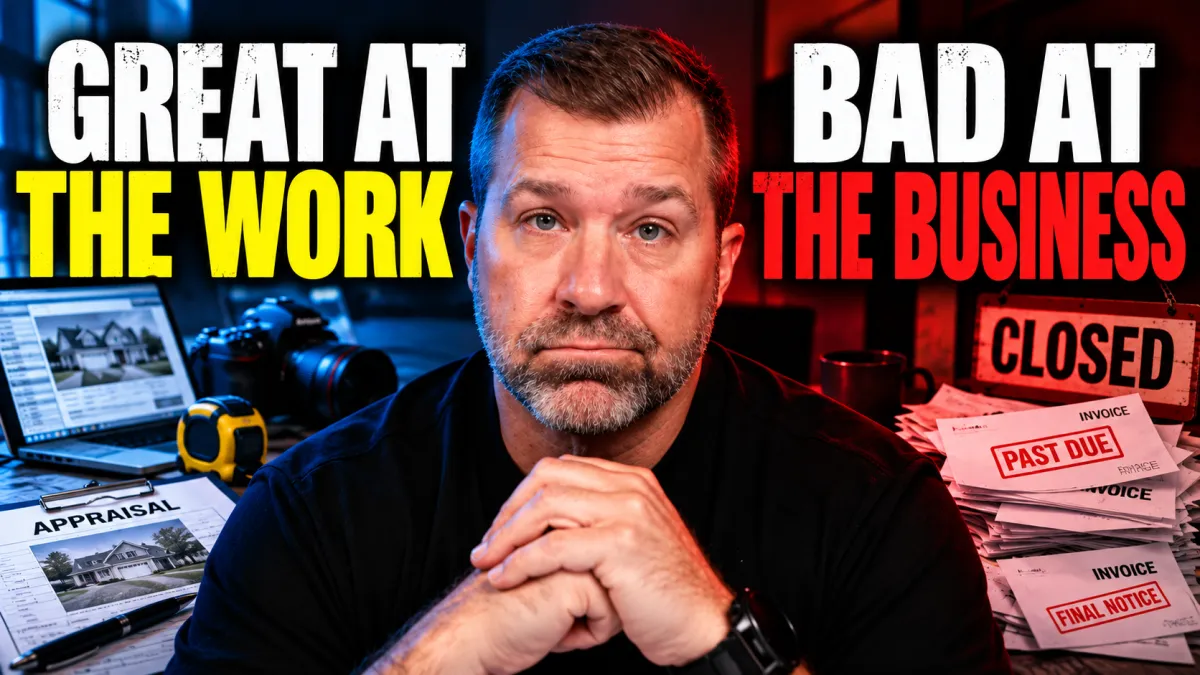
Great at the work, Bad at the business!
Why Real Estate Appraisers Make Terrible Business Owners (And How to Fix It)
I want to introduce you to a paradox. Maybe you're familiar with it if you've ever read Michael Gerber's great book, The E-Myth. He calls it the 'fatal assumption' and says it like this: "you cannot be good enough at your craft to overcome being bad at running your business and still achieve the results you want."
What Gerber was saying is that most people get into business because they're good at something, he calls that the 'Technician' role, and then they assume that skill will carry them. The problem is that it rarely does. In fact, it's often the very thing that spells their demise when trying to build a business around that skill…the one they were so good at to begin with.
The better you are at appraising, the better you are at selling, the better you are at a particular martial art or at designing widgets on your 3-D printer, the more likely it is that you suck at the business of doing those things. Not despite your skill, but instead, because of it.
And I know how that sounds. It sounds backwards. It sounds like the kind of thing someone says to get you to click on a video or listen to their podcast. But I guarantee you that I'm not saying any of this to be deliberately controversial. I mean, remember, people like Michael Gerber said it long before me, so get mad at them if you want to, but don’t discount the truthfulness of the claim, especially if you're struggling in business.
The goal of this episode is simply to wake you up to one of the big, and most common struggles in the world of the small business owner, and especially the world of skilled technicians and service providers like appraisers, attorneys, accountants, car mechanics, plumbers, and so on.
Here's the concept I want to give you, and it comes from psychology, the sports world, and the corporate world, not real estate.
There's a well-documented phenomenon in athletics called 'transfer of training'. I witnessed it time and time again in the martial arts world as well. The idea is simple: a skill you master in one domain doesn't automatically move into a different domain, even when the domains may look related on the surface. A world-class quarterback who can read a defense in three-tenths of a second, who processes more information in a play snap than most of us do in an hour, put that same guy in front of a whiteboard trying to teach a fifteen-year-old how to read that same defense, and watch him struggle. Not because he doesn't understand it. Because doing the thing and teaching the thing are different skills wearing the same jersey.
Same story in the dojo. I've watched black belts, genuinely gifted ones, people whose technique is clean and fast and very competent, completely fail to get a white belt to understand a single technique or body movement. The black belt's body knows the movement intuitively from doing it hundreds or thousands of times on their way to that rank. But knowing it in your hips and explaining it in words or concepts that build another person's skill are not the same knowledge. One is craft and maybe a personal gift, the other is instruction. One is ability, the other is leadership. You can max out one and still be a beginner at the other.
Being a great appraiser, for example, develops a very specific set of instincts. Documenting every assumption so nobody can come back and poke a hole in your logic. Explaining your rational. Treating every judgment call as something to be defended if needed. Extracting adjustments from market data. Working alone, one file at a time, in sequence, checking your own work before anyone else sees it. And treating risk; the professional, reputational, and liability risk, as the enemy. Those are simply some of what makes you good at the job. Without those traits, the product sucks, the liability goes up, and the potential for lawsuits and licensure issues goes way up.
Now put that same brain and set of character and personality traits in charge of building a business that requires marketing, budgeting, investment, long-term thinking, relationship building, and cash flow management and we see something different.
Precision under pressure becomes analysis paralysis on a decision that just needed to get made. Documenting every assumption becomes an inability to trust a gut call or hand something off to someone else without a twelve-step SOP first. Treating judgment calls as things to defend becomes treating every new idea; a new fee structure, a new service line, a new hire, and a new client as a liability, and a cost, to justify instead of an experiment to run. And bringing in specific talent to handle specific parts of the process is almost a personal attack on your character instead of a smart business decision.
Solo, sequential thinking becomes an inability to build systems that work without you standing over them. And risk-aversion, the professional virtue of most appraisers, becomes the single most reliable way to keep a business small forever.
Now run the same calculations on someone really good at a martial art, or at wiring up a new home project, or installing a furnace in a remodeled house. The things that make each one of those individuals good at those specific roles are not necessarily the same skills that will make them a great entrepreneur and business owner.
Here's the part that makes this worse than it sounds, because your craft and your business both live in the same brain and the same body, and it feels like the skill should transfer. You're smart, you're analytical, and you solve problems for a living. Surely that must translate into building a company, right?
That feeling, the false sense that expertise in one area automatically buys you competence in another, is exactly what keeps professions like appraisers, tradespeople, and service professionals stuck longer than almost anyone else. You think you're already doing the business thinking, because it feels like the same kind of thinking. I'm here to tell you that it isn’t. And if you're a real estate agent listening to this thinking, "glad this one's not about me", sorry friends, you’re next.
Agents have the exact same problem, just the mirror image. An agent's craft isn't analytical, it's relational, personality, and sales based. Reading a room, building rapport fast, asking good questions, dealing with objections, closing a conversation, and making a stranger trust you as quickly as possible. That’s a genuinely hard skill and also a genuinely valuable one. It's often also a set of skills appraisers typically don’t share at scale. But relational mastery doesn't transfer to running a business any more than analytical mastery does. It's a completely different muscle. And this is exactly why the natural career endpoint for most agents isn't "build an independent brokerage." It's "go get folded into a bigger machine that handles the parts I was never taught and don’t want to handle".
That's not an insult, by the way. That's rational behavior and it's worked for many decades on the real estate sales side. Nobody sat these agents down and taught them systems, marketing infrastructure, or financial structure. The brokerage model exists, in large part, because an entire industry quietly agreed that great salespeople shouldn't have to also become business builders, they should just plug into someone else's system and trade a chunk of their commission for not having to solve that problem. It's the transfer-of-training gap, built into an entire industry's business model.
So, here's the reframe, and this is the whole episode in one sentence: the skills that made you good at your craft are not the skills that will make you good at building a business. They were never supposed to be. And the fix isn't getting better at your craft. You're probably already good enough at that. The fix is deliberately building a second, separate skill set that has almost nothing to do with the work you do all day.
Let me give you that list, because vague advice like "learn business skills" is worthless. Here's specifically what you're missing:
Systems thinking. That's the ability to document a process once so it doesn't live only in your head, to design workflows that function whether you're in the room or not, and to spot the one actual bottleneck capping your growth instead of chasing the ten fake ones that feel more urgent.
Financial literacy, the business kind, not the personal kind. Reading your own P&L and knowing what it's telling you to do about it. Pricing for margin instead of pricing for what feels fair. Understanding the difference between cash flow and revenue, because that cash gap kills more small businesses than bad work ever does.
Marketing and positioning. Being able to say, in one sentence, why someone should choose you specifically. Building a pipeline that doesn't depend on a fake personality or your special charisma showing up in a room every single day. Getting comfortable being visible before you feel ready for it. Being comfortable showing and telling the world that you exist and why.
Delegation and leverage. Hiring for the weaknesses you are never going to fix in yourself. Giving tasks away before you feel like you can afford to, even though many of the tasks you’re probably doing are low dollar tasks that the CEO should not be doing. Trusting outcomes over methods. Letting someone do the job differently than you would and being okay when it still works.
Strategic decision-making. Making a call with seventy percent of the information, on a deadline, without waiting for certainty that probably isn’t coming. Knowing the difference between a reversible decision, which you should make fast, and an irreversible one, which deserves real thought. Saying no to a good opportunity because it isn't the right one.
And identity flexibility. This is a big one and probably the hardest for most people. It's separating "I am a great appraiser" or "I am a great agent" from "I am a business owner." Those are two vastly different jobs. There might be some overlap in some areas, but they’re very different. And it means getting comfortable being a beginner again, in public, at the exact thing you now need to learn, after years of being the expert in the room.
Here’s the takeaway from all of this; the more talented you are at your craft, the longer this keeps you stuck. Not because talent is bad, but because your ability to do your craft so well speaks louder than your ability to run a great business doing that thing. It generates just enough income and just enough validation to make skipping the harder, less comfortable business skills feel doable. And why wouldn’t you think that, after all, you’ve been in ‘business’ for 10, 15, maybe 20 years or more and made a decent living from it. It’s just that being really good at the thing is often what's keeping you from the next thing, which could be better and more life-giving than the thing you’re really good at right now.
So, here's what I want you to do, starting this week:
Look back at your last five real business decisions, not appraisal decisions, not technical stuff, not client decisions; business decisions. A recent hire, a price or fee change (probably long overdue), a marketing move, a software tool you bought or didn't buy. For each one, ask yourself honestly: did I make that decision the way I make decisions in my craft? Slow. Exhaustive. Defensible from every angle before I'd move. Or, if you're in sales, did I make it the way I'd handle a client conversation? Fast, on gut instinct, with no actual system or reasoning behind it, just a feeling that it would work out?
If most of your answers land on one side of that, and for almost everyone listening, they will, that's not necessarily a character flaw. It’s just proof of where your training transferred, and where it didn't.
Then pick one thing off that list I just gave you; Systems, finance, marketing, delegation, decision-making, identity. Just one. And practice it this week, badly, on purpose. Document one process you've only ever kept in your head. Give away one task you've been holding onto. Say no to one thing that felt good but wasn't right. You are not trying to become an expert business builder by Friday. You are trying to prove to yourself that the skill is learnable, the same way appraising or sales was learnable once, before you were any good at it either.
And, if you find yourself resisting developing any of those other business builder skills, again, not necessarily a character flaw, but it could be the very signal you need that you might be better off worki g for someone else who is a business builder. There’s nothing wrong with that and it's the reason the real estate brokerage model has worked so well for so long.
I started in the appraisal industry 26 years ago at what would be considered a big firm today. Multiple offices around the state, residential and commercial divisions, lots of appraisers, lots of tech, lots of support, and it worked really well for precisely the reasons I’m talking about in this episode. The owner wasn’t just technically good at appraising; he was also a business builder and he knew he could hire out all the things he wasn’t necessarily good at, but maybe more importantly, shouldn’t be doing if he wanted the business to grow, and it did.
Listen, I also understand the benefits of the one-person business, and especially in changing markets and economies. Not everybody wants to build a big business. Many of you have zero interest in managing people and being accountable. I get it!
I’m not encouraging anyone to build something they have no interest in owning once they build it. All of the things we’ve talked about in this episode plague the one-person business just as they do the 10-person business, although the stakes are often higher for the one-person business to only have technical skills because every dollar coming in relies solely on you. Your livelihood depends on your ability to market, sell, manage, invest, and build systems that allow you to maximize the only real asset you have available to you, which is your hours.
After more than a decade of coaching a lot of one-person businesses, I can tell that most of them are plagued with the very disease we’ve been talking about this whole time. They’re good at the technical work that led them to start their business, and they’re really bad at all of the things that running a successful business requires. And I must emphasize the ‘requires’ part because every business has a variety of required functions and roles, you’re just not doing most of them. Just because you’ve made it this far without doing any marketing, strategic planning, or systems development does not mean you’ve been doing it right, or that it couldn’t be way better.
The irony of all of this is that all of those other skills would make life way easier for you and business way better, even if you choose to stay a one-person business forever. Again, there’s nothing wrong with being a one-person business.
The more important questions to ask are:
1.How much of my life is being frittered away doing things I shouldn’t be doing as the business owner?
2.How fragile is my business if the market changes? If interest rates change? If the powers that be decide to change something about the way we do business.
3.What happens to my income if I’m not able to do all of the things I do in the business today?
These are real questions that demand real answers if you care about your income and your future. If you don’t, well then none of this is for you and I just appreciate you watching or listening this long. But, if you do care, if you have thought about these things and have just never done anything about it, maybe its time. Maybe this episode is just the reminder you needed that it's time to address the reality that, just becasue I’m good at this one thing, does not mean I’m necessarily good at running a business doing that thing.
By the way, we talk about and I teach on this very topic all the time in the Appraiser Increase Academy. If you’re an appraiser and know your life and business could be better, come join a community that helps you build that very thing. You can check it out completely free for 30 days at www.coachblaine.com/freemonth
At some point you have to accept that when you decided to work for yourself, you actually chose two professions.
You chose to become an appraiser, an agent, an accountant, an attorney, or whatever your technical craft happens to be. And then the day you decided to go into business for yourself, you unknowingly chose a second profession, which was to become a business owner.
The problem is that nobody told you that the second profession would require a completely different education and set of skills. Skills that, in many cases, you haven’t built.
You spent years, sometimes decades, learning the first one. Thousands of hours, classes, mentors, mistakes, real world experience and lots of reps. You studied for tests, got licenses and certifications, learned from people who knew more than you did, screwed things up, corrected them, and eventually became pretty damn good at what you do.
Then most of you walked into the second profession assuming you would somehow just figure it out. And there’s a massive difference between having twenty years of business experience and having one year of business experience repeated twenty times.
I think that describes a lot of really talented people. They’ve spent ten, fifteen, maybe twenty years getting progressively better at their craft while their actual business skills barely moved.
They became better, faster, maybe even more efficient and more profitable. But they never deliberately became better marketers, better leaders, better decision makers, better financial managers, or better business owners. And time alone isn’t going to fix that.
You have to actually practice those things. You have to study them. You have to make mistakes at them. You have to ask for help. You have to be willing to suck at some of them for a while. In essence, you have to be willing to suck at something again before you can start to be good at it, just like when you were a new appraiser, agent, or piano player.
Look, I get it, you’re pretty used to knowing the answer. You’re used to people coming to you because you know what you’re doing. And, for my appraiser colleagues, you’re used to getting paid to give people your opinions about real estate, so many of you think your opinions on everything else have more value than they do.
Building the next version of your business might require you to give up some of that expertise and your opinions about them for a while and become a beginner again. Maybe the next level of your career has very little to do with becoming better at the thing you already know how to do.
Maybe it’s time to give the business owner the same attention and respect you gave the technician. Study it. Practice it. Get coached in it. Make mistakes at it. Get better at it.
You already know how to be the expert in the room.
Maybe the next chapter requires you to become a student again.